
What’s the difference between polished nickel and chrome? A designer weighs in.
You’re in the final stages of a kitchen remodel, and it’s time to choose finishes for the faucet and cabinet hardware. But a trip to the home improvement store could soon land you in the middle of a design debate: polished nickel or chrome?
While personal preference for your home’s aesthetic matters, understanding the difference between polished nickel and chrome goes beyond their shiny appearances. We asked Amy Wadhwani, an interior designer at NFM, for advice on what you should know about these two finishes to ensure you’re making the right decision for your home improvement projects.
Polished Nickel vs. Chrome
There’s truly never a dull moment when you choose either a polished nickel or chrome finish for your home, but you can tell the difference just by looking at them.
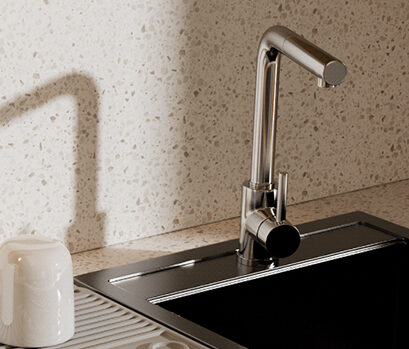
“Polished nickel has a warmer, yellow hue, and chrome has a shiny mirror-like finish with a blueish shine,” explains Wadhwani.
You might already be leaning toward Team Chrome or Team Polished Nickel because you prefer one’s appearance over the other’s. But choosing a finish based on good looks alone isn’t always wise. Here are some factors to consider when choosing between these two popular finishes.
Installation
The mirror-like shine of chrome makes it a perfect finish if you’re looking for a retro vibe to your home. But it’s also at home in modern kitchens with a cooler color palette. It also works well with basic neutrals like white, gray, or black.
Polished nickel also pleases the eye, although the veneer offers more sheen than shine. “I prefer polished nickel because it is a more subdued, warmer look that pairs well with almost any style and color palette,” says Wadhwani.
Chances are, if you settle on styles of faucet and hardware you like, you can get them in either chrome or polished nickel. It’s a good idea, however, to commit to a single finish in the same room for a cohesive all-warm or all-cool appearance.
Cleaning and Maintenance
“Polished nickel is a little easier to maintain because it won’t show water spots and fingerprints quite as much as chrome will,” says Wadhwani. Cleaning is easy with a vinegar and water solution or a little liquid soap and water.
While chrome might need more frequent cleaning to remove those spots and prints, it’s not a chore to do it. Wadhwani says all you need is a microfiber cloth and an all-purpose cleaner to clean chrome. To remove any calcium and mineral spots that might form on the chrome, she recommends mixing a lemon juice and water solution and applying to the affected areas with a soft toothbrush.
Durability and Longevity
Both chrome and polished nickel stand up well to scratching and corrosion. But Wadhwani says chrome is the more resilient choice for high-moisture areas like kitchens and bathrooms because polished nickel can tarnish over time.
It pays to take care of either finish if you want them to last. “Chrome tends to look dull when damaged and is difficult to repair once broken or cracked,” says Wadhwani. To eliminate scratches on polished nickel, she recommends gently sanding the finish.
Frequently Asked Questions
- Can polished nickel and chrome finishes be used in outdoor applications?Yes, both polished nickel and chrome can be used as a finish for outdoor kitchens and other applications. Choose a sturdy metal under either finish, like brass, that will ensure better longevity, then clean and maintain it just as you would if it were indoors.
- Which finish is more expensive, polished nickel or chrome?While the nickel itself is more expensive than chrome, the polishing process is a bit more intricate, further driving up the cost of polished nickel. Chrome, on the other hand, is more widely available than polished nickel, making it the more economical choice.
- Are there any eco-friendly alternatives to polished nickel and chrome finishes?Chrome finishing involves chemicals and processes that lead to water and soil contamination, so they are not considered eco-friendly. Nickel plating tends to use more sustainable practices, including low or zero volatile organic compounds (VOCs). That said, some manufacturers instead look to composite electroless nickel coatings, which1 .